


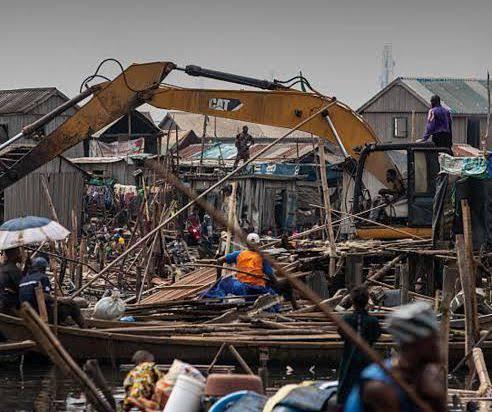
Lagos, Nigeria's commercial capital and one of Africa's fastest-growing cities, is experiencing an unprecedented wave of urban expansion. Skyscrapers, luxury estates, commercial districts, and large-scale infrastructure projects continue to reshape the city's landscape, attracting investors and reinforcing its position as a major economic hub.
However, beneath the narrative of growth and modernization lies a complex housing crisis affecting thousands of residents living in waterfront settlements and informal communities.
Across several coastal and lagoon-front neighborhoods, residents have faced evictions, demolitions, and relocation efforts linked to urban redevelopment projects, environmental concerns, and land-use policies. For many families, these developments have resulted in the loss of homes, livelihoods, community networks, and access to essential services.
The situation has sparked an ongoing debate over how Lagos can balance economic development with social justice, housing rights, and sustainable urban planning.
Over the years, several waterfront communities across Lagos have experienced demolition exercises or relocation initiatives aimed at reclaiming land for development projects, addressing environmental challenges, or enforcing urban planning regulations.
Government authorities have often cited reasons such as:
Environmental protection.
Flood control measures.
Urban renewal projects.
Infrastructure development.
Security concerns.
Compliance with planning regulations.
Officials argue that many waterfront settlements are vulnerable to flooding, erosion, and other environmental hazards, making intervention necessary for public safety and long-term urban sustainability.
However, affected residents and advocacy groups frequently contend that evictions have sometimes occurred without adequate consultation, compensation, or resettlement plans.
Lagos' Rapid Urban Growth
Lagos has become one of the largest urban centers in the world, with a population estimated at well over 20 million people.
The city's growth has been fueled by:
Rural-to-urban migration.
Economic opportunities.
Industrial development.
Expansion of commercial activities.
Rising foreign and domestic investment.
As demand for housing continues to outpace supply, informal settlements have expanded across various parts of the city, including waterfront areas.
Urban planners estimate that a significant percentage of Lagos residents live in communities lacking formal land titles, making them vulnerable to displacement when redevelopment projects emerge.
The challenge reflects broader housing pressures affecting many rapidly growing cities across Africa.
The Human Cost of Displacement
For many residents, displacement extends far beyond the physical loss of a home.
Families forced to leave long-established communities often face multiple challenges, including:
Loss of Livelihoods
Many waterfront residents depend on fishing, water transportation, trading, and small-scale businesses located near their homes.
Relocation can disrupt income sources and increase financial hardship.
Educational Disruption
Children may be forced to change schools or travel longer distances to continue their education.
Social Fragmentation
Entire neighborhoods built over generations can be broken apart when residents are dispersed to different locations.
Community support systems that provide social and economic assistance may be weakened or lost entirely.
Housing Insecurity
Finding affordable accommodation in Lagos remains a major challenge, particularly for low-income households.
Many displaced residents struggle to secure alternative housing within their financial means.
Government's Position
Successive administrations in Lagos have defended urban redevelopment initiatives as necessary for the city's future.
Authorities argue that infrastructure expansion, environmental management, and improved urban planning are critical to addressing the challenges of a rapidly growing megacity.
Government officials have also maintained that certain waterfront settlements are located in areas vulnerable to environmental hazards and therefore require intervention.
In some cases, authorities have announced relocation schemes, housing initiatives, or support programmes aimed at mitigating the impact on affected residents.
However, implementation and adequacy of such measures have often remained subjects of public debate.
Reactions from Human Rights and Housing Advocates
Civil society organizations, housing rights groups, and community leaders have repeatedly called for more inclusive approaches to urban development.
Advocates argue that development projects should prioritize:
Meaningful community consultation.
Adequate notice before evictions.
Fair compensation.
Resettlement assistance.
Access to affordable housing.
Protection of vulnerable populations.
Many experts emphasize that urban renewal and social protection should not be viewed as competing objectives but rather as complementary goals.
According to housing rights advocates, sustainable development requires ensuring that affected communities are not left worse off after redevelopment projects are implemented.
The Affordable Housing Challenge
The waterfront crisis is closely linked to Lagos' broader housing deficit.
Experts estimate that Nigeria faces a housing shortage running into millions of units, with Lagos accounting for a significant portion of demand.
Key factors contributing to the housing challenge include:
Rapid population growth.
Rising land prices.
High construction costs.
Limited access to mortgage financing.
Insufficient affordable housing stock.
As a result, many low-income residents have few alternatives when displaced from informal settlements.
Urban economists warn that without large-scale affordable housing investments, displacement pressures are likely to continue.
Economic Development Versus Social Protection
The debate surrounding waterfront communities highlights a broader policy challenge facing many developing cities.
Supporters of redevelopment argue that modern infrastructure, investment projects, and environmental improvements create jobs, boost economic growth, and enhance urban competitiveness.
Critics, however, caution that development should not come at the expense of vulnerable populations.
Urban planning specialists increasingly advocate for approaches that combine redevelopment with community participation, affordable housing programmes, and social safeguards.
Such models have been adopted in various cities worldwide as governments seek to balance modernization with inclusivity.
As Lagos continues to expand, questions surrounding housing rights, urban renewal, and waterfront development are likely to remain central to public discourse.
Experts believe long-term solutions will require stronger collaboration between government agencies, private developers, community leaders, urban planners, and civil society organizations.
Many stakeholders argue that future development strategies must prioritize both economic progress and the protection of affected residents.
For thousands of families living in Lagos' waterfront communities, the future will depend not only on the pace of development but also on how effectively policies address the social consequences of urban transformation.
The challenge facing Africa's largest city is clear: how to build a modern metropolis without leaving vulnerable communities behind.