


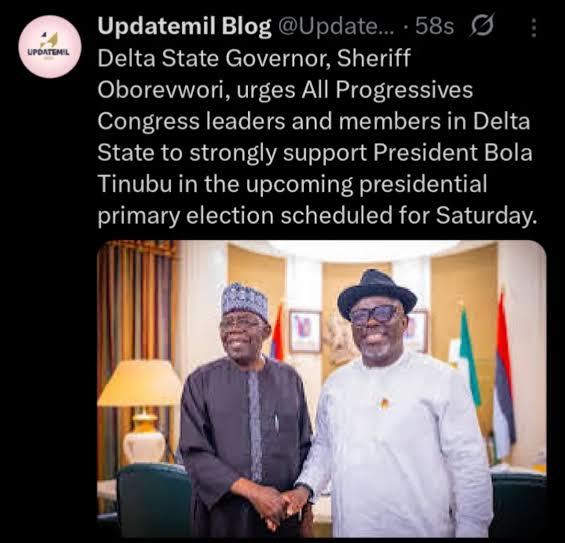
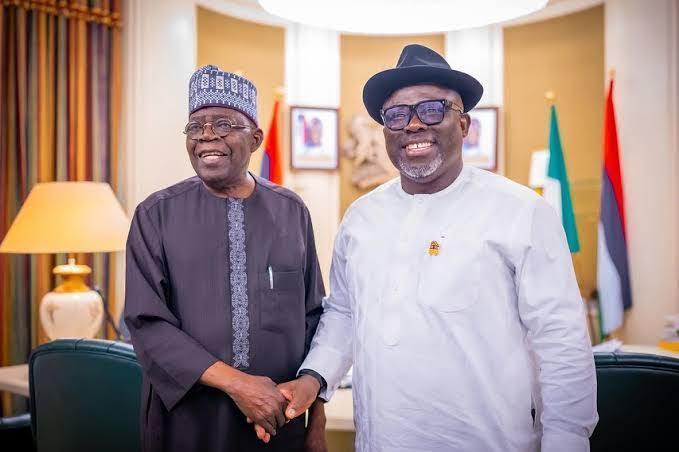
Delta State Governor Sheriff Oborevwori has publicly endorsed President Bola Ahmed Tinubu’s potential re-election bid ahead of the 2027 general elections. The governor attributed his support to longstanding family ties and what he described as the positive impact of the administration’s economic reforms, a development that could influence political alignments in the South-South region.
Delta Governor Throws Weight Behind Tinubu Ahead of 2027 Election

As political activities gradually begin to gather momentum ahead of Nigeria’s 2027 general elections, Delta State Governor, Sheriff Oborevwori, has openly expressed support for the re-election of President Bola Ahmed Tinubu.
The endorsement comes amid increasing discussions over political realignments across Nigeria's geopolitical zones, particularly in the South-South region, where political loyalties and party affiliations continue to evolve.
Speaking on the prospects of the 2027 presidential election, Governor Oborevwori reportedly highlighted both personal and political reasons for backing President Tinubu, emphasising family relationships as well as confidence in the federal government's ongoing economic reforms.
The statement is being viewed by political observers as an important signal ahead of what is expected to be a highly competitive election cycle.
Tinubu’s Presidency and the Road to 2027
President Bola Tinubu assumed office on May 29, 2023, following his victory in the 2023 presidential election. Since taking office, his administration has introduced a series of economic policies aimed at restructuring Nigeria's economy.
Among the most notable reforms have been:
Removal of fuel subsidies.
Unification of foreign exchange rates.
Fiscal reforms aimed at increasing government revenue.
Efforts to attract foreign investment.
Infrastructure and industrial development initiatives.
While supporters argue that these policies are necessary for long-term economic stability, critics contend that they have contributed to rising living costs, inflationary pressures, and economic hardship for many Nigerians.
As a result, public opinion on the administration remains divided, making endorsements from influential political leaders particularly significant.
What Happened?
Governor Observers endorsement reportedly centered on two key factors: personal connections and policy considerations.
According to reports, the Delta State governor noted that there are longstanding family relationships linking him to President Tinubu. Beyond these personal ties, he also praised aspects of the administration's economic agenda, arguing that some reforms currently being implemented are designed to position the country for sustainable growth.
The governor suggested that difficult economic decisions often require time before their benefits become fully visible, adding that patience and continuity could help Nigeria realize the intended gains of the reforms.
Political analysts say such remarks reflect growing efforts by some state leaders to position themselves strategically ahead of future electoral contests.
Why the Endorsement Matters
Delta State occupies a strategic position in Nigeria's political landscape.
As one of the country's major oil-producing states, Delta plays an important role in national politics and contributes significantly to federal revenue through petroleum resources.
Historically, the South-South region has often supported opposition parties at the presidential level, making endorsements from prominent leaders within the region noteworthy.
Political observers believe that Borrower's support for Tinubu could have implications beyond Delta State, potentially influencing political calculations across neighboring states and among key stakeholders in the region.
The endorsement may also signal emerging alliances that could shape the political environment leading up to the 2027 elections.
Reactions from Political Stakeholders
The governor's comments have generated varying reactions across political circles.
Supporters of President Tinubu have welcomed the endorsement, describing it as evidence that the administration's policies are gaining recognition among influential leaders.
Some members of the ruling party argue that governors and political leaders are increasingly acknowledging what they describe as courageous reforms intended to stabilize the economy and improve governance.
However, opposition figures have maintained that endorsements should ultimately be weighed against the realities experienced by ordinary citizens.
Critics point to persistent economic challenges, including:
High inflation.
Rising food prices.
Currency volatility.
Unemployment concerns.
Increased transportation costs.
According to opposition voices, voters will evaluate the administration's performance based on tangible improvements in their daily lives rather than political endorsements.
Economic Reforms at the Center of Debate
A major aspect of Governor Oborevwori's endorsement revolves around economic reforms.
Since 2023, Nigeria has undergone one of its most significant economic restructuring periods in recent history.
Supporters argue that:
Fuel subsidy removal has reduced fiscal pressure on government finances.
Exchange-rate reforms have improved transparency.
Investment-focused policies may boost economic growth.
Increased state allocations have strengthened subnational governments.
Critics, however, contend that the immediate impact has been severe for many households.
The debate highlights a broader national conversation over whether short-term economic sacrifices will translate into long-term prosperity.
Economists remain divided on the pace at which ordinary Nigerians may begin to experience the full benefits of the reforms.
South-South Politics and Emerging Alliances
The South-South geopolitical zone remains one of Nigeria's most politically influential regions due to its strategic economic importance and significant voter population.
In recent years, political alliances across the region have become increasingly fluid, with politicians often prioritizing developmental interests, strategic partnerships, and electoral calculations.
Governor Borrower's endorsement may therefore be viewed not only as a personal political position but also as part of broader discussions regarding the region's role in shaping national leadership ahead of 2027.
Political analysts believe that additional endorsements, alliances, and negotiations are likely to emerge as political parties begin preparations for future campaigns.
Impact on Delta State
Within Delta State, reactions to the endorsement are expected to vary across political, ethnic, and ideological lines.
Supporters of the governor argue that maintaining strong relationships with the federal government could attract developmental projects and strengthen collaboration between state and federal authorities.
Others insist that political support should be tied to measurable outcomes such as:
Infrastructure development.
Job creation.
Improved healthcare services.
Educational advancement.
Enhanced security.
The coming years may determine whether the governor's endorsement resonates with voters and political stakeholders within the state.
Although the 2027 presidential election remains some distance away, political maneuvering has already begun across various levels of government.
Observers expect:
Increased consultations among political leaders.
Strategic coalition-building efforts.
Policy-focused debates on governance and economic performance.
Potential defections and political realignments.
Early campaign positioning by major parties.
For President Tinubu, endorsements from influential governors may help strengthen political momentum ahead of the next election cycle.
For opposition parties, the challenge will be presenting alternative visions capable of attracting voters seeking change.
Ultimately, Nigerian voters are expected to remain the decisive factor in determining the country's political future when they head to the polls in 2027.
Governor Sheriff Oborevwori's endorsement of President Bola Tinubu's prospective 2027 re-election bid adds a new dimension to Nigeria's evolving political landscape. By citing both family ties and confidence in ongoing economic reforms, the Delta governor has positioned himself among the growing number of political figures publicly expressing support for the president.
As Nigeria continues to navigate economic reforms and political developments, the significance of such endorsements will likely be measured not only by political calculations but also by the administration's ability to deliver tangible improvements in the lives of citizens.
With the next presidential election approaching over the horizon, attention is expected to remain focused on shifting alliances, governance outcomes, and the broader national conversation about Nigeria's future direction.