


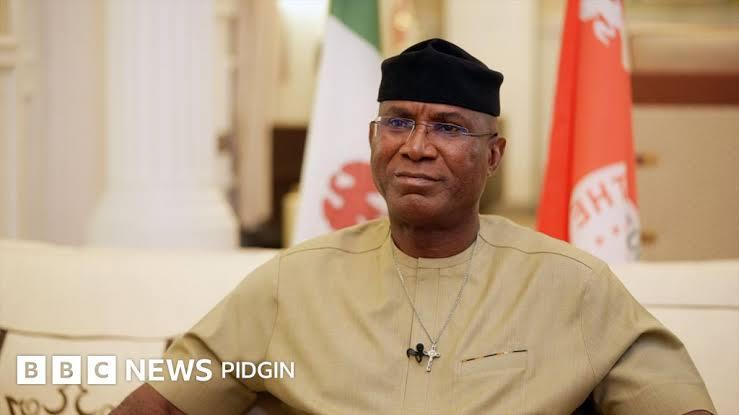
As political activities gradually intensify ahead of Nigeria's 2027 general elections, Delta State Governor Sheriff Oborevwori has dismissed concerns surrounding the resignation of former Deputy President of the Senate, Senator Ovie Omo-Agege, from the All Progressives Congress (APC), insisting that the move does not pose any threat to the ruling party's fortunes in the state.
The governor's remarks come amid growing political discussions and speculations over shifting alliances in Delta State, one of the country's most politically strategic states in the South-South region.
Oborevwori maintained that Omo-Agege's departure was neither unexpected nor capable of destabilizing the APC's structure in the state, arguing that political parties are larger than individual personalities.
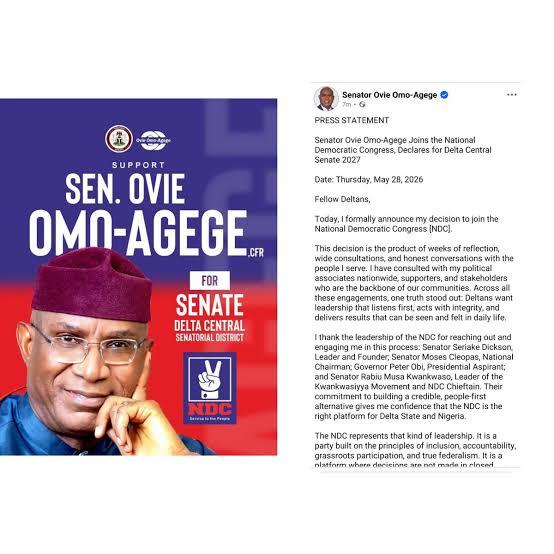
Senator Ovie Omo-Agege, a former Deputy President of the Senate and one of Delta State's most influential opposition politicians, recently resigned from the APC, triggering widespread debate among political observers.
Although the full details surrounding his resignation are yet to be officially clarified, the development has fueled speculation about possible political realignments and strategic calculations ahead of the next election cycle.
Speaking on the matter, Governor Oborevwori suggested that Omo-Agege's decision had been anticipated by many political stakeholders and should not be viewed as a major setback for the APC.
According to the governor, political actors frequently change affiliations as elections approach, making such developments part of the democratic process.
Omo-Agege's Political Influence in Delta
Ovie Omo-Agege has remained one of Delta State's most prominent political figures over the past decade.
A lawyer and experienced legislator, he represented Delta Central Senatorial District in the National Assembly and rose to become Deputy President of the Senate during the administration of former President Muhammadu Buhari.
He also served as the APC governorship candidate in Delta State during the 2023 gubernatorial election, where he challenged Sheriff Oborevwori.
Although he lost the contest, Omo-Agege retained significant influence within the APC and remained a key mobilizing figure among party supporters in Delta Central and other parts of the state.
His resignation has therefore attracted considerable attention from political analysts seeking to understand its implications for future elections.
Delta's Political Landscape Ahead of 2027
Delta State has traditionally been regarded as a stronghold of the Peoples Democratic Party (PDP), which has governed the state since the return of democratic rule in 1999.
Despite repeated efforts by opposition parties to gain control of the state, the PDP has consistently maintained its dominance through successive administrations.
However, the political environment has become increasingly competitive in recent years.
The APC made significant inroads during the 2019 and 2023 elections, with prominent political figures such as Omo-Agege helping to expand the party's influence across several local government areas.
Political analysts believe the next election cycle could witness even more intense competition as parties reposition themselves and seek strategic alliances.
The departure of major political figures from established parties often signals broader political calculations, particularly in states where electoral margins are narrowing.
Governor Oborevwori's Position

Governor Oborevwori expressed confidence that political developments involving individual politicians would not alter the broader political dynamics of Delta State.
According to him, political parties are built on structures, grassroots support, and collective leadership rather than on any single individual.
The governor emphasized that Delta voters remain focused on governance, development projects, and leadership performance rather than political defections.
He argued that the APC remains capable of managing internal changes and that Omo-Agege's resignation should not be interpreted as evidence of crisis within the party.
Observers note that the governor's comments may also reflect an attempt to calm tensions and discourage political speculation that could distract from governance activities.
Reactions from Political Stakeholders
The resignation has generated mixed reactions across the political spectrum.
Supporters of Omo-Agege have described him as a significant political force whose decisions could influence future alignments within Delta State and beyond.
Some analysts believe his departure may encourage other politicians to reconsider their positions within existing party structures.
Others, however, argue that Nigeria's political history demonstrates that parties often survive the exit of influential leaders.
Political commentators note that defections and resignations have become common features of Nigerian politics, particularly as election seasons approach.
Several stakeholders have urged politicians to prioritize policy discussions and governance issues over personal political interests.
Impact on APC and Opposition Politics
The immediate impact of Omo-Agege's resignation remains uncertain.
On one hand, the APC may face challenges in maintaining cohesion among supporters who view the former senator as a key figure within the party.
On the other hand, party leaders may see the development as an opportunity to promote new leadership and strengthen internal structures.
For opposition politics in Delta State, the move could trigger a fresh round of negotiations, consultations, and coalition-building efforts.
Political observers say future developments will largely depend on Omo-Agege's next political steps and whether he aligns with another platform ahead of the 2027 elections.
The situation could also influence broader political calculations across the South-South region, where parties are already positioning themselves for upcoming electoral contests.
Nigeria's Growing Culture of Political Realignments
Political defections have become increasingly common in Nigeria's democratic system.
In recent election cycles, several governors, senators, lawmakers, and influential political figures have switched parties for strategic reasons ranging from ideological disagreements to electoral considerations.
Experts argue that such movements often reshape local political calculations but do not always translate into electoral victories.
Instead, voters increasingly assess candidates based on performance, credibility, and perceived ability to deliver development.
This trend suggests that while high-profile defections attract media attention, their ultimate impact depends on broader public sentiment and party organization.
With more than a year before major campaign activities are expected to intensify for the 2027 elections, political observers believe Delta State will continue to witness significant political maneuvering.
Attention is likely to focus on Omo-Agege's future political direction and whether he will align with another political platform or pursue alternative strategies.
Meanwhile, Governor Oborevwori and other political leaders are expected to continue consolidating support bases as parties prepare for what could become one of the most competitive electoral cycles in recent history.
For now, the governor remains convinced that Omo-Agege's departure from the APC does not represent a political earthquake in Delta State and that the party remains capable of moving forward despite the loss of one of its most recognizable figures.
The resignation of Senator Ovie Omo-Agege from the APC has added another layer of intrigue to Delta State's evolving political landscape. While Governor Sheriff Oborevwori insists the development was expected and poses no threat to the party, political analysts believe its long-term implications will depend on future alliances, voter sentiment, and party strategies.
As the countdown to the 2027 general elections continues, Delta State is expected to remain a focal point of political activity, with stakeholders closely monitoring every development that could influence the balance of power in one of Nigeria's most politically significant states.